
For hyaluronic acid fillers, skin boosters, and other aesthetic injectable products, the syringe serves as more than just a container. It is part of the final delivery system. Because many cosmetic injectable products are supplied in prefilled syringes, every component can affect assembly, injection performance, appearance, and end-user experience.
When buyers choose plunger rods and backstops for cosmetic syringes, the real question is not only whether the parts fit before sterilization. The more important consideration is whether the complete syringe system can still be assembled correctly, operate smoothly, and maintain dimensional and visual stability after the intended sterilization cycle.
Why Do Cosmetic Syringes Need Heat-Resistant Components?
Cosmetic gel is usually much more viscous than ordinary aqueous injections. During injection, the user may also face tissue counterpressure. When smaller needles such as 27G or 30G are used, the required push force can increase further.
This is why the plunger rod must transfer force steadily to the rubber stopper. The backstop or finger grip must also provide the user with sufficient finger support. If the plunger rod bends, loosens, or does not match the stopper thread, the injection feel can become unstable.
A properly designed backstop can improve grip and control, particularly when dispensing highly viscous formulations or injecting against tissue resistance. However, the backstop must remain securely attached to the syringe flange throughout sterilization, storage, transportation, and use.
Moist Heat Sterilization Changes the Buying Criteria
Some cosmetic injectable products undergo moist heat sterilization after they are filled. In these applications, the plunger rod and backstop may be exposed to elevated temperature, humidity, pressure, and subsequent thermal contraction during cooling.
A component that fits well before sterilization may not perform the same after sterilization. Plastic parts may show slight shrinkage, warpage, discoloration, haze, or changes in mechanical stress and dimensional stability. A backstop may become loose. A plunger rod may no longer engage with the stopper as firmly as expected.
For this reason, buyers should not evaluate plunger rods and backstops only through room-temperature assembly tests. The components should also be evaluated as part of the complete syringe system under the actual or representative sterilization cycle.
When PP Plunger Rods and Backstops Are Used
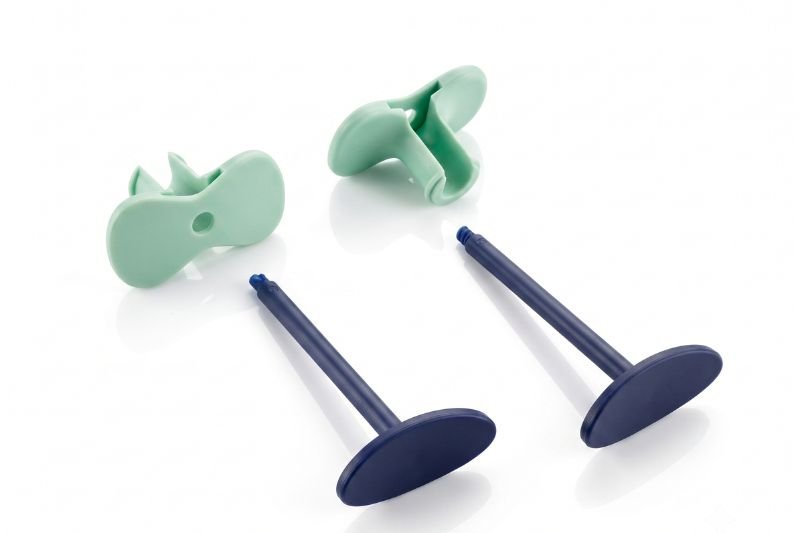
PP (Polypropylene) plunger rods and backstops are often suitable for cosmetic syringe projects where cost control, batch stability, and practical sterilization compatibility are more important than high transparency.
PP is commonly used for medical and laboratory plastic components that need practical heat resistance. When sourcing components for cosmetic syringes, PP is often a suitable starting material for:
- high-volume cosmetic syringe projects;
- cost-sensitive OEM or wholesale projects;
- white, milky white, opaque, or semi-translucent plunger rods;
- standard plunger rod and backstop designs;
- projects where function and cost are more important than premium visual clarity.
PP is usually the practical option when the buyer wants a stable, cost-effective component for standard cosmetic syringe projects.
However, the PP grade, component geometry, molding quality, sterilization temperature, exposure time, and assembly conditions can all affect final performance. Material selection should therefore be supported by functional testing rather than based on resin type alone.
When PC Plunger Rods and Backstops Make Sense
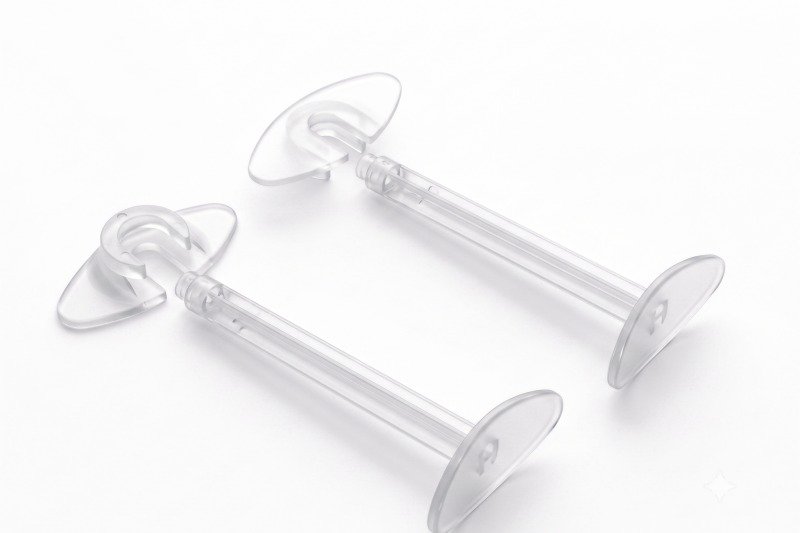
PC (Polycarbonate) plunger rods are usually selected when the buyer wants a transparent and premium-looking finished syringe. For aesthetic products, appearance is important because the syringe may be displayed to clinics, distributors, doctors, and end-users.
PC is known for clarity, rigidity, and strength. For cosmetic syringe projects, PC may be suitable for:
- premium cosmetic fillers;
- premium aesthetic injectable products;
- transparent plunger rods for better product presentation;
- brands that care about finished syringe appearance;
- display packaging or doctor-facing product lines;
- projects that can accept higher material cost and extra validation.
PC is a premium option when transparency and visual presentation matter.
Nevertheless, transparent appearance alone should not determine material selection. Buyers should also evaluate dimensional stability, thread engagement, mechanical strength, discoloration risk, and performance after the intended sterilization cycle.
Confirm the Assembly Sequence Before Choosing a Material
Before choosing PP or PC, buyers should confirm when the plunger rod and backstop will be assembled.
Key questions include:
- Will the plunger rod be assembled before moist heat sterilization?
- Will the backstop be assembled before moist heat sterilization?
- Will the packaged product go through any secondary surface treatment after filling and packaging?
- Will the components be sterilized separately or as part of the fully assembled syringe system?
- What are the target sterilization temperature, holding time, pressure, and number of cycles?
If the components are assembled before sterilization, material heat resistance and dimensional stability become more important. If they are assembled after sterilization, the buyer needs to consider the aseptic assembly environment and packaging workflow.
The assembly sequence can also affect component tolerances. A backstop installed before sterilization must remain firmly attached after thermal exposure, while a component installed afterward must be compatible with the buyer’s cleanroom, aseptic assembly, and packaging procedures.
Information to Provide Before Ordering
The more clearly buyers provide their syringe format and sterilization conditions, the faster a supplier can recommend the right plunger rod and backstop.
| Information to Provide | Why It Matters |
|---|---|
| Syringe volume | Determines rod length and backstop size |
| Barrel type | Confirms compatibility with glass, COC, COP, Luer-lock, or Luer-slip syringe formats |
| Flange shape | Affects backstop fit |
| Stopper type | Determines rod thread or snap-fit compatibility |
| Formulation viscosity range | Helps estimate push-force requirements |
| Needle size | Smaller needles may increase the required injection force |
| Sterilization cycle | Supports material, dimensional, and functional validation |
| Assembly sequence | Confirms whether components are installed before or after sterilization |
| Material preference | PP, PC, or other options |
| Appearance requirement | Opaque, white, transparent, colored |
| Annual volume | Affects tooling, cost, and supply plan |
| Packaging configuration | Helps assess whether the components may experience additional mechanical or thermal stress |
| Required testing | Clarifies expectations for dimensional, assembly, push-force, and sterilization tests |
For cosmetic syringe projects, it is also helpful to inform the supplier whether the finished syringe will be used for standard clinic supplies, OEM private labeling, premium filler packaging, or sample testing.
Buyers should ideally provide drawings, syringe samples, stopper specifications, target tolerances, and sterilization parameters. Testing the plunger rod, stopper, barrel, and backstop as a complete system can help identify compatibility issues before bulk production.
How Noterd Supports Component Selection
Noterd Tech supports syringe buyers with PP and PC plunger rods and backstops for different syringe formats, material requirements, visual specifications, assembly sequences, and sterilization conditions.
For cosmetic syringe projects, buyers can send us the syringe size, barrel type, stopper type, sterilization cycle, assembly sequence, and appearance requirements. Our team can help check suitable plunger rods and backstop options for testing and bulk production.
PP is usually more suitable for standard, cost-effective, high-volume syringe projects. PC is more suitable when transparency and premium presentation are important. However, neither material should be selected solely by appearance or general material properties. Both must be validated with the actual syringe, stopper, assembly process, and sterilization cycle.
Contact Noterd Tech to discuss heat-resistant PP or PC plunger rods and backstops for your cosmetic prefillable syringe project.